



In this article we answer the following questions:
- Why do men lose muscle mass as they age?
- What is sarcopenia and when does it start?
- How does diet affect muscle loss in men?
- What is the best natural way to prevent muscle loss?
- How does oxidative stress damage muscle tissue?
Why does muscle loss happen?
-
Hormonal decline (testosterone)
From around age 30, your testosterone levels begin to decline. As levels fall, the body gradually loses its ability to build and repair muscle tissue and starts breaking it down instead. Lower testosterone encourages the body to store more abdominal fat, and that fat produces inflammatory signals that accelerate muscle breakdown even further.
-
Inactivity, disuse atrophy, and chronic pain
Your muscles grow when you use them and shrink when you don’t. When men become less active, whether through a desk-bound lifestyle, an injury, or ongoing pain, muscle fibres begin to waste away in a process called disuse atrophy. Chronic pain is a particularly sneaky culprit here. Pain makes you move less, moving less causes more muscle loss, and less muscle means more pain. Many men find themselves trapped in this cycle without realising what is driving it.
-
The acidogenic diet
What you eat has a direct effect on your muscles. Diets heavy in processed foods, red meat, and refined carbohydrates, and light on fruits and vegetables, push the body into a state of mild but chronic acidity known as low-grade metabolic acidosis. When the body becomes too acidic, it breaks down muscle tissue to release compounds that help neutralise that acid. In other words, your body starts cannibalising your muscles simply to restore its chemical balance.
-
Oxidative stress
Every time your muscles work, they produce unstable molecules called free radicals. These molecules are missing an electron, which makes them destructive. They travel through your body stealing electrons from healthy cells, damaging muscle fibres, disrupting the tiny structures inside cells that produce energy, and speeding up muscle cell death. Think of it like a cut apple turning brown, or metal beginning to rust.
Core strength: your body’s foundation
When most men think about muscle, they think about the ones they work in the gym. The muscles that matter most as you age are the ones you can’t see in the mirror. Your core is a deep, interconnected system of muscles spanning your trunk, including your diaphragm, deep abdominals, pelvic floor, and the muscles running alongside your spine. These muscles do not just give you a flat stomach; they hold your entire body upright, protect your spine, and power virtually every movement you make.
Most men do not give their core a second thought until their back starts playing up or they realise getting off the floor is harder than it used to be. The truth is that core muscle loss tends to begin in the mid-30s, long before any warning signs appear. By the time back pain, balance problems, or stiffness become a daily reality, the underlying muscle loss has often been building for years. Everyday tasks that once required no thought, such as getting out of a chair, lifting something heavy, or climbing a flight of stairs, become genuine effort. Keeping your core strong is one of the most important things you can do for your long-term health and independence.
The consequences of muscle loss in men
Men with significant muscle loss are more likely to suffer fractures from low-impact falls. As muscle mass drops, metabolism slows, fat accumulates more easily, and the body becomes less efficient at managing blood sugar. Energy levels fall, confidence fades, and the mental toll of losing physical independence can be considerable.
How to fight back: prevention and natural support
-
Resistance exercise
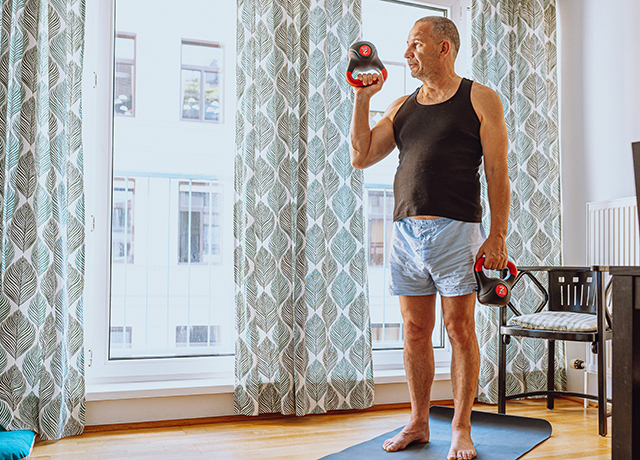
The single most effective thing any man can do to protect his muscle mass is to resistance train regularly. Two to four sessions a week of push-ups, squats, planks, lunges, or light lifting is enough to stimulate muscle repair and growth. Exercise also triggers the body’s own antioxidant defences, helping to clear the oxidative stress that damages muscle tissue from within.
-
Diet and pH balance
Eating to protect your muscles means shifting towards foods that reduce acid load. Fill your plate with fruits, vegetables, nuts, and legumes, and ease back on processed foods and refined sugar. A Mediterranean-style way of eating is one of the most well-supported dietary approaches for healthy ageing.
For targeted support, A.Vogel Multiforce Alkaline Powder is a well-researched solution. This multi-mineral powder, combining calcium, magnesium, and potassium, supports the body’s natural acid-buffering processes, directly addressing one of the key triggers of muscle protein breakdown. A.Vogel Multiforce’s alkalising effect has been confirmed in a double-blind, placebo-controlled clinical trial, and helps buffer the acid build-up that causes muscle fatigue during exercise.
-
Addressing oxidative stress
Giving your body the tools to fight back against free radical damage is essential. Oxiprovin is made from South African grape seed extract and delivers a concentrated dose of oligomeric proanthocyanidins (OPCs), among the most powerful antioxidants found in nature. What sets Oxiprovin apart is that it doesn’t just neutralise free radicals. Oxiprovin reduces free radical production in the first place, repairs existing cellular damage, protects DNA and cell membranes, and stimulates the body’s own natural protective compounds. For any man serious about holding on to his strength as he ages, Oxiprovin works at the root of the problem, not the surface.
Your muscles have served you well. With the right knowledge, the right habits, and the right natural support, you can return the favour. Movement, good food, a balanced body chemistry, and targeted supplementation with products like Multiforce and Oxiprovin are not complicated interventions. They are simple, consistent choices that add up to a stronger, more capable, and more independent life.

