






In this article we answer the following questions:
- Why do the testicles sit outside the body?
- What are the signs of testicular cancer?
- How do you examine your testicles for lumps?
- What causes pain or swelling in the testicles?
- How is testicular cancer diagnosed?
Many men delay getting checked because they feel embarrassed or hope the problem will go away. Most changes in the testicles can be treated, especially when you act early.
This article explains how your testes work, what can affect them, and how to check yourself. Knowing what is normal for you is the best way to take the fear out of the unknown.
Getting to know your testes
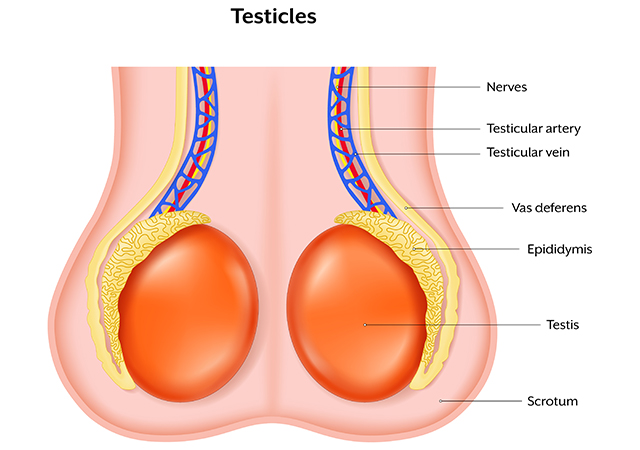
Your testes (testicles) are two oval-shaped glands inside the scrotum, the loose pouch of skin below the penis. Each one consists of tightly coiled tubes called seminiferous tubules, where sperm are produced.
Behind each testicle is the epididymis, a coiled tube that collects and stores sperm as they mature. Running up from each testicle is the spermatic cord. It carries blood vessels and the vas deferens, the tube that transports sperm.
It is completely normal for one testicle to hang a little lower or feel slightly larger than the other. The epididymis at the back may also feel like a soft, rope-like ridge.
What your testes do for you
Your testes have two important jobs. They make sperm and testosterone. Testosterone is the hormone that controls your libido, muscle strength, bone density, mood and energy levels. Your brain and pituitary gland guide this process, so the testes work as part of your wider hormonal system.
Why your testicles sit outside your body
It can feel like a design flaw to put such an important part of your body in such a vulnerable position. The reason is temperature. Sperm production works best a little below your core body temperature, and the scrotum helps keep your testes cool.
The scrotum regulates temperature by adjusting. In warm conditions, it relaxes, so the testes hang lower, away from the body’s heat. In the cold, a muscle called the cremaster draws them closer for warmth.
Common conditions that can affect your testes
- Testicular torsion
Torsion is when the spermatic cord twists and cuts off the blood supply to the testicle. It can happen at any age, but is more common from the start of puberty into the mid-twenties. Torsion causes sudden, severe pain, usually on one side.
Torsion is an emergency. Go to the nearest emergency unit immediately and don’t wait to see whether it passes. A twisted testicle needs urgent assessment. Delaying treatment can lead to the testicle dying and having to be removed. - Epididymitis
Epididymitis is inflammation of the epididymis, the coiled tube at the back of the testicle. The pain usually builds gradually. You may notice swelling, warmth, or discomfort when you pass urine. Bacterial infections, including urinary tract infections and sexually transmitted infections, are common causes.
- Orchitis
Orchitis is inflammation of the testicle itself. Viral infections, including mumps and bacterial infections can cause orchitis. When the epididymis is inflamed too, it’s called epididymo-orchitis. The testicle may feel swollen, tender and heavy, and you may feel generally unwell.
- Hydrocele
A hydrocele is a collection of fluid around the testicle. It usually feels like a soft, painless swelling. Some resolve on their own. Larger ones may need to be drained or repaired with a minor operation. Even though a hydrocele is often harmless, it’s important to have any new swelling checked.
- Varicocele
A varicocele is a set of enlarged veins in the scrotum, similar to varicose veins in the legs. Many men feel nothing. Others notice a dull, dragging ache, often worse at the end of the day. Treatment is usually only needed if it causes discomfort or affects fertility.
- Trauma
A knock to the testes during sport, a fall or an accident can be extremely painful. If the pain is severe or persistent, if swelling or bruising grows, or if you feel sick, consult a healthcare professional as soon as possible. Wear protective gear for contact sports to protect yourself.
What you need to know about testicular cancer
Cancer is a hard word to read. Let’s start with the facts. The Cancer Association of South Africa (CANSA) reports that the lifetime risk for men in South Africa is 1 in 2 000. Most testicular cancers can be detected early, because a lump or swelling is often something you can feel yourself.
Here is what to look out for:
- A painless lump or swelling in one or both testicles. This is the most frequent sign.
- A feeling of heaviness or pain in a testicle.
- An ache in the lower abdomen, back or groin.
Men who have had an undescended testicle, a family history of testicular cancer or HIV infection are at higher risk for testicular cancer. Having a risk factor doesn’t mean you will develop cancer. You could also develop testicular cancer with none of the risk factors present.
How testicular cancer is diagnosed
Your doctor will examine you and may order a scrotal ultrasound and blood tests. If cancer is suspected, the next step is usually surgery to remove the affected testicle. Testicular cancer is one of the few cancers where a biopsy is deliberately avoided. A biopsy through the scrotum could spread the cancer into the scrotum and change how it drains to the lymph nodes.
Can you prevent testicular cancer?
There is no proven way to prevent testicular cancer, because we don’t know exactly what causes it. A balanced lifestyle is the best way to lower your general cancer risk. Follow a Mediterranean diet, prioritising fresh, seasonal fruit and vegetables, legumes and whole grains. Limit red and processed meat. Stay active, aiming for 150 to 300 minutes of moderate exercise a week. Avoid tobacco, keep alcohol to a minimum and maintain a healthy weight.
How to examine yourself
The best time to examine your testicles is after a warm bath or shower, when the scrotal skin is relaxed.
- Stand in front of a mirror and look for any swelling or changes in the scrotal skin
- Support the scrotum in your palm, then examine one testicle at a time.
- Gently roll each testicle between your thumb and fingers. It should feel smooth and firm, like a hard-boiled egg without its shell.
- Find the epididymis at the back and the cord leading upward. These are normal structures.
- Note any lump, hardness, change in size or shape, or area of pain.
Do the same for the other side. Remember that one testicle may be slightly different from the other. You’re looking for changes.
Your next step
Get to know what’s normal for your testicles. Check yourself once a month, and don’t wait if something feels different. A lump, swelling, heaviness or pain needs a professional examination, even if it doesn’t hurt and even if you feel awkward about it. Healthcare professionals won’t judge you, and they will help you understand what is going on.
Looking after your testes is a simple act of self-care, and it starts with paying attention.
References and additional reading:
- American Cancer Society (2025) ACS guideline for diet and physical activity for cancer prevention. Available at: https://www.cancer.org/cancer/risk-prevention/diet-physical-activity/acs-guidelines-nutrition-physical-activity-cancer-prevention.html
- American Cancer Society (2025) Tests for testicular cancer. Available at: https://www.cancer.org/cancer/types/testicular-cancer/detection-diagnosis-staging/how-diagnosed.html
- Better Health Channel (n.d.) Testicle injuries and conditions. Victoria State Government, Department of Health. Available at: https://www.betterhealth.vic.gov.au/health/conditionsandtreatments/testicle-injuries-and-conditions
- Cancer Association of South Africa (CANSA) (2012) Men & cancer. Available at: https://cansa.org.za/mens-health/
- Cancer Association of South Africa (CANSA) (2024) Testicular cancer. Available at: https://cansa.org.za/testicular-cancer/
- Cancer Association of South Africa (CANSA) (2026) CANSA fact sheet on testicular cancer: National Cancer Registry 2024. Available at: https://cansa.org.za/files/2026/06/CANSA-Fact-Sheet-on-Testicular-Cancer-NCR-2024-web-June-2026.pdf
- Cleveland Clinic (2023) Testicular contusion: causes, symptoms, risks and treatment. Available at: https://my.clevelandclinic.org/health/diseases/22814-testicular-trauma
- International Agency for Research on Cancer (n.d.) South Africa: Global Cancer Observatory fact sheet. World Health Organization. Available at: https://gco.iarc.who.int/media/globocan/factsheets/populations/710-south-africa-fact-sheet.pdf
- Mayo Clinic (2024) Orchitis: symptoms and causes. Available at: https://www.mayoclinic.org/diseases-conditions/orchitis/symptoms-causes/syc-20375860
- Mayo Clinic (2025) Epididymitis: symptoms and causes. Available at: https://www.mayoclinic.org/diseases-conditions/epididymitis/symptoms-causes/syc-20363853
- National Cancer Institute (2026) Testicular cancer diagnosis and prognosis. Available at: https://www.cancer.gov/types/testicular/diagnosis-prognosis