



In this article we answer the following questions:
- What is MSM?
- How much MSM should you take for joint pain or arthritis?
- How long does it take for MSM to start working?
- Why does the purity of MSM (such as OptiMSM) matter?
- Can THRESHHold help joint pain in runners?
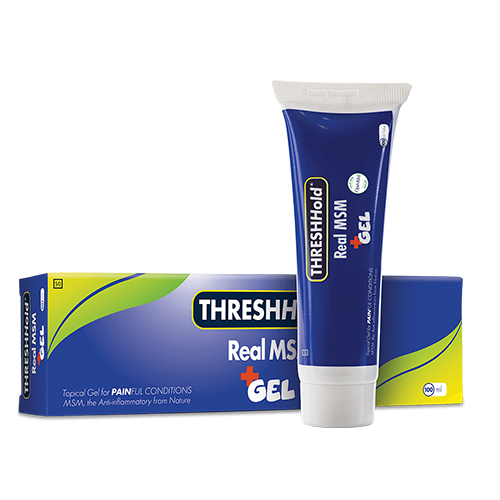
For the past 26 years, Wietse has taken THRESHHold Real MSM tablets daily. When he is in training and running long distances, he uses 6 tablets a day. When training becomes less intense, he reduces his dose to 3 tablets daily. If he stops taking THRESHHold, his knees ache and become painful within 2 weeks. In his words, “THRESHHold works, BUT it is all about the dose.”
Wietse’s story is a reminder that joint support is not a one-size-fits-all approach. To get the most out of THRESHHold, it’s important to find the correct dose for your body.
What is MSM, and why does it matter for joints?
MSM (methylsulphonylmethane) is a naturally occurring organic sulphur compound found in fruits, vegetables, grains and milk. MSM is produced in small amounts by healthy gut bacteria. Sulphur is the third most abundant element in the human body by weight, and it forms the backbone of connective tissue. It is found in the tendons, ligaments, cartilage, skin, and the extracellular matrix that structurally supports our cells.
For a distance runner like Wietse, who has spent decades asking his tendons, ligaments and cartilage to absorb the repeated stress of marathons, keeping his connective tissue well-supplied with MSM is foundational to staying on the road.
Even people who aren’t tackling one of the world’s most challenging road races can benefit from a daily dose of MSM. MSM is an anti-inflammatory that can improve pain, stiffness and swelling, specifically for people who have arthritis.

The science behind the THRESHHold dose
MSM’s story begins in the pulp and paper industry, where biochemist Robert Herschler noticed that factory workers handling wood pulp reported their joint pain easing while at work. Investigating this phenomenon led him and cardiologist Dr Stanley Jacob of Oregon Health Sciences University to an organically bonded sulphur, contained in the paper bark, that the factory workers were absorbing through their hands. That sulphur is MSM, a compound Dr Jacob used with more than 20,000 chronic pain patients over his career.
MSM is water-soluble, so the body doesn’t store it up the way it does fat-soluble nutrients. Whatever isn’t needed is flushed out through urine. That’s why consistent daily use is more important than a single dose; the body needs a steady, ongoing supply to keep levels topped up long enough to work on inflammation. A daily dose of 3 to 6 grams can help ease pain, stiffness and swelling.
For everyday exercise recovery, 3 grams a day has been shown to help with muscle soreness and post-workout inflammation, giving the body a better chance to bounce back between sessions.
The purity of the MSM is vital. OptiMSM is the purest form of MSM commercially available and is produced through a four-stage distillation process. OptiMSM is also verified free of banned substances for competitive athletes and safe to take in high doses.
THRESHHold RealMSM tablets each contain 1000 mg of OptiMSM
Finding your own dose
There are two rules for anyone using MSM – dose and patience.
The dose needs to match what your body needs. If you’re managing pain in your muscles, joints, tendons or ligaments, don’t be afraid to increase your intake until you feel a real difference. In most cases, 3 to 6 tablets a day is enough to ease chronic pain, but you may need more.
The second rule is to give it time. MSM needs to build up in the body before it gets to work on the inflammation that causes pain. This doesn’t happen in a day or two. Most people need to consistently take the right dose for at least 3 to 4 weeks to feel meaningful results.
As Wietse discovered over many years, the THRESHHold difference is all about finding the right dose and sticking with it long enough to feel the effect.
References and additional reading:
- Drugs.com (n.d.) Methylsulfonylmethane (MSM): uses, benefits & dosage. Available at: https://www.drugs.com/npp/methylsulfonylmethane-msm.html
- Impact Guru (2026) What is sulphur deficiency in humans? Symptoms, causes & food. Available at: https://www.impactguru.com/info/what-is-sulphur-deficiency-in-humans/
- MaxFit.ee (2026) Long-term MSM use: is it safe? Available at: https://maxfit.ee/en/blog/msm-long-term
- Ostrovit (2026) MSM – dosage of the organic sulphur. Available at: https://ostrovit.com/en/blog/msm-dosage-or-what-portion-of-organic-sulfur-is-recommended-1666003144.html
- Supersonic Food (2025) Organic sulfur dosage: MSM step by step. Available at: https://supersonicfood.com/en/blogs/poradnik/organic-sulfur-dosage-msm-step-by-step
- VKM (Norwegian Scientific Committee for Food and Environment) (2020) Risk assessment of methylsulfonylmethane (MSM) in food supplements. Available at: https://vkm.no/download/18.5760e5891790d83258db71c1/1620111015082/Risk%20assessment%20of%20methylsulfonylmethane%20(MSM).pdf