







In this article we answer the following questions:
- How do constant alerts affect your nervous system?
- Why is doomscrolling bad for you?
- How does spending time in nature calm your nervous system?
- Why is boredom good for you?
- What small changes can you make to calm your nervous system?
In this article, we explore the effects of living with constant stressors and how you can create room for presence and restoration.
What constant alerts do to your body
Your stress response is built for short bursts. When your brain senses a threat, your nervous system releases adrenaline and cortisol. Your heart beats faster, your blood pressure rises, and your body releases sugar for quick energy. Digestion and other non-essential functions slow down. Once the danger passes, your body should settle again.
That reset can’t happen when the next alert arrives a few minutes later. When stressors are always present, the stress response stays switched on. Prolonged exposure to stress hormones is linked to poor sleep, headaches, anxiety, depression, a weak immune system, and high blood pressure and heart disease. An overstimulated nervous system struggles to switch off, even when nothing is wrong.
The danger of doomscrolling
Most of us know the feeling. You pick up your phone to check one thing, and twenty minutes later you’re still scrolling. Our brains are hardwired to want to know more when a topic worries or fascinates us, making it difficult to stop doomscrolling. Social media platforms want to keep you online as long as possible to collect advertising revenue. They program their algorithms to feed you more and more of what you interact with to lock you into doomscrolling.
The internet is a source of valuable information. It’s impossible to avoid entirely. The problem is reaching for your phone automatically, without having a good reason.
Before you unlock your phone, stop. Ask yourself what you are looking for. You don’t need to cut your screen time to zero; just be intentional about the time you spend online.

We often drift from one distraction to the next without noticing what we are doing or how we feel. We check emails while eating, listen to podcasts while walking and scroll while watching television. Our bodies are busy, but we are not really present in the moment.
Every time we switch between tasks, our brain has to refocus. Digital multitasking causes mental fatigue and poor focus. A scattered, tired mind can’t relax and get out of high-alert mode. It’s important to reconnect your mind and body and be present in the moment.
The importance of being bored
When did you last feel bored? We often feel the need to fill any spare moment immediately. We’ve learnt to treat boredom as a problem that must be fixed.
Boredom is useful. Think about how children play when they have nothing to do. Before long, they invent games, build worlds out of cardboard boxes and turn the garden into an adventure. When your mind has nothing to focus on, it wanders, and that wandering gives us space to rest, reflect and process the day. Boredom lets ideas take shape. When your mind has room to roam, it makes connections a busy, constantly stimulated brain can’t.
Next time you feel the urge to fill a quiet moment, leave it empty. Stare out of the window, watch the clouds and let your mind wander.
Spend time in nature
Nature is one of the simplest ways to calm your nervous system. Twenty minutes outdoors is enough to lower cortisol, the stress hormone. Even ten minutes in a natural setting can improve how you feel.
Sit quietly in your garden, go for a walk in your local park or botanical gardens. Have your morning coffee outdoors. Leave your phone behind and give your attention to your surroundings.

Natural support for stressful days
..
 |
When the alerts never stop, your nerves can start to feel frayed. A.Vogel Neuroforce is a homeopathic nerve tonic that supports your nervous system when you feel stress and emotional strain. A.Vogel Neuroforce is made for that on-edge, worn-out feeling, with mild anxiety, nervous tension and mental fatigue. |
| . | . |
 |
Some moments need a faster answer than a deep breath. The Irma’s Rescue range combines homeopathic medicines and flower essences in six gentle formulas for life’s overwhelming moments. Stress Rescue eases nervous tension and constant worry, Panic Rescue calms sudden, overwhelming fear, and Burnout Rescue supports you when you’re mentally drained. |
| . | . |
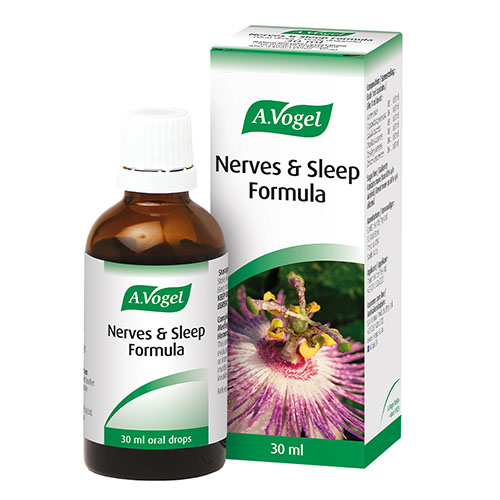 |
Shutting down your laptop for the day doesn’t shut down your nervous system overload. A.Vogel Nerves & Sleep Formula is a homeopathic remedy for nervousness, nervous exhaustion and sleeplessness. A.Vogel Nerves & Sleep Formula is made for that tired-but-wired feeling at the end of a long, connected day. |
| . | . |
Small, realistic changes
You don’t need to throw away your phone or overhaul your life. You can care for your nervous system with small, repeatable moments that fit into your day.
Here are a few places to start:
- Take three slow breaths before you reach for your phone.
- Enjoy at least one screen-free meal a day.
- Spend 10 to 20 minutes outside, without a screen.
- Keep your phone out of the bedroom at night.
- Recognise that boredom is not a bad thing, and enjoy it.
- Turn off non-essential notifications.
- Set an evening technology cut-off time.
Pick one and try it for a week. Once it feels natural, add another. We can’t find calm by escaping our lives, but we can practice calm within them. If you experience ongoing anxiety, low mood or trouble sleeping, speak to a healthcare professional.
References and additional reading:
- American Psychological Association (2023) Stress effects on the body, 8 March. Available at: https://www.apa.org/topics/stress/body
- American Psychological Association (n.d.) Multitasking: Switching costs. Available at: https://www.apa.org/topics/research/multitasking
- Frontiers (2019) Stressed? Take a 20-minute nature pill, 9 April. Available at: https://www.frontiersin.org/news/2019/04/09/20-minute-nature-pill-relieves-stress
- Hasan, M.K. (2024) ‘Digital multitasking and hyperactivity: unveiling the hidden costs to brain health’, Annals of Medicine and Surgery, 86(11), pp. 6371–6373. Available at: https://pmc.ncbi.nlm.nih.gov/articles/PMC11543232/
- Cleveland Clinic (2024) What happens during fight-or-flight response?, 22 July. Available at: https://health.clevelandclinic.org/what-happens-to-your-body-during-the-fight-or-flight-response
- Harvard Health Publishing (2020) Stress and the heart: Lessons from the pandemic, 14 October. Available at: https://www.health.harvard.edu/blog/stress-and-the-heart-lessons-from-the-pandemic-2020101421094
- Harvard Health Publishing (2024) Doomscrolling dangers. Available at: https://www.health.harvard.edu/mind-and-mood/doomscrolling-dangers
- Mayo Clinic (n.d.) Chronic stress puts your health at risk. Available at: https://www.mayoclinic.org/healthy-lifestyle/stress-management/in-depth/stress/art-20046037
- Dekker, C.A., Baumgartner, S.E., Sumter, S.R. and Ohme, J. (2025) ‘Beyond the buzz: investigating the effects of a notification-disabling intervention on smartphone behavior and digital well-being’, Media Psychology, 28(1), pp. 162–188. Available at: https://www.tandfonline.com/doi/full/10.1080/15213269.2024.2334025
